|

|
|
LEADERSHIP ASSESSMENT |
|
 |
|
Relationship Team level:
Assessments:
We have 360 degree Assessments available for teams that would like to provide each other with feedback on the following constructs:
Emotional Intelligence through the Bar – On EQi
Management of Diversity
Leadership Effectiveness
We also have Team climate assessments available that focus on constructs like trust, team decision making, interdependencies, leadership roles, conflict resolution etc.
Conflict resolution Intervention:
We acquired advanced conflict resolution skills and experience over the past 15 years. We can assist with conflict resolution in relationships and teams as well as conflict between different groups or departments in the organization.
Team development interventions:
We have assisted numerous teams in enhancing their decision making abilities, interpersonal relationships, direction, empowerment etc. We utilize low and or high rope exercises, other forms of experiential learning etc. We have experienced that it is essential to create opportunities for interaction on the team dynamics and to provide feedback to team members and to create mutual understanding and to build the collective subconscious by sharing memories and celebrating successes.
Leadership Team building Interventions:
An opportunity is created for a natural leadership team or for a cross- functional project team to attend a workshop in order for the team to develop leadership capability, to be able to share the leadership role, depending on the specialist area that is addressed.
Leadership gained extraordinary attention during the past couple of years, as more and more business leaders have come to realise the importance of providing hope and direction during exponential change.
Change and the complexity of today’s business environment, require Leadership’ capacity to be build throughout the organisation, even those not currently in leadership positions. Given these realities we developed our unique approach to leadership capability development.
The intervention consists of a pre – and post – assessment of constructs relating to leadership capability as well as a two day workshop.
The workshop is customized according to the strengths and weaknesses of the individuals attending and the team leadership profile. This two-day process is participant driven with analogies, exercises and discussions to enhance learning about leadership effectiveness.
Participants also get an opportunity to assess their leadership capacity, their level of trustworthiness, their ability to instil confidence in others etc. Low rope exercises, group feedback, and self-disclosure enhance learning throughout this workshop. They acquire confidence and have opportunities to practice specific leadership roles during the program.
Course learners leave the workshop with a personal leadership development plan to improve the effectiveness of their teams and organisations.
Learners will:
- understand the concept of leadership, the difference between management and leadership and able to illustrate these concepts with examples from nature and African leadership lessons
- have the opportunity to clarify their individual purposes and formulate their team and organisation’s purposes. This will enable them to create meaning for themselves and others
- learn how to create processes and structures to enable implementation, feedback and learning
- learn how to connect team members by building trust, facilitating conflict and developing leaders
Our program is accredited with the Services Seta.
We developed a model to address the enhancement of leadership capacity and at the workshop we transfer knowledge and skill. The model enables clear understanding of the 20 percent leadership input that will have an 80 percent impact on followers and subsequently the organisation. Therefore it is called Leadership Leveraging Roles.
The three leadership roles are leverage points to enhance the progress of teams:
· Through “Clarifying Purpose” team members are being motivated
· “Creating Processes” enables implementation and feedback
· “Connecting People” ensures collaboration and a sense of belonging
“Leadership leveraging roles” utilizes analogies from nature (African Elephant Matriarch) and lessons from African leaders.
We can draw numerous examples of excellence in leadership capability from the Matriarch.
• The matriarch sets the herd’s direction and pace.
• Whether they flee or charge is up to her.
• Without the matriarch’s knowledge of where to find food and water the herd may starve.
• Cows generally do not become matriarchs until they are forty or fifty years old. They hold the position until they die.
• The matriarch would smell the air with upraised trunk to be able to warn the herd of danger.
• A distinct hierarchy is apparent in the herd. They follow the matriarch willingly.
• The matriarch makes use of a memory bank. Information is stored about the territory to guide the herd during drought or crisis.
• e.g. Elephants’ cave-digging project, relocation Addo, etc.
We have access to an amazing venue the “Elephant Sanctuary” close to Hartbeespoort Dam where the participants can have a close encounter with elephants.

Team Emotional Intelligence
We designed a workshop to enhance Team Emotional Intelligence. Team Emotional Intelligence is about:
– Bringing emotions deliberately to the surface and understand how they affect the team’s work
– Behaving in ways that build relationships both inside and outside the team
– Strengthening the team’s ability to face challenges
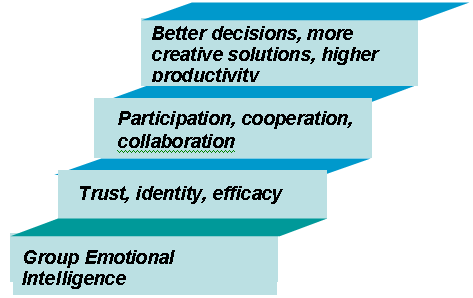
Teams are more creative and productive when they achieve high levels of participation, cooperation and collaboration among members
3 Conditions need to be present before such behaviors can occur:
- mutual trust among members
- a sense of group identity (a sense of belonging to a worthwhile group)
- A sense of group efficacy (a belief that group members are more effective working together than apart)
At the heart of these conditions are emotions.
Trust, identity and efficacy arise in environment where emotion is well handled.
The deliverable of the workshop is amongst others Emotional Intelligent Ground rules or Norms for the team.
Emotionally intelligent norms are the attitudes and behaviours that eventually become habits that support behaviours for building:
– Trust
– Group Identity
– Group Efficiency